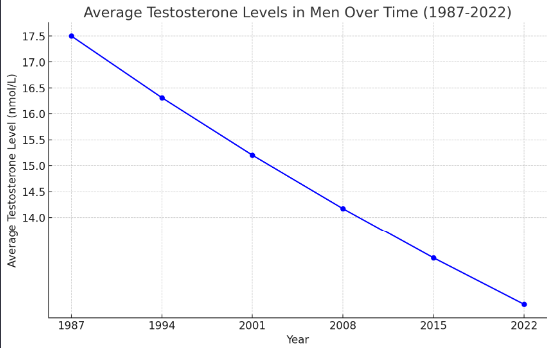
Aliveness, Discretionary Time & Strike Zones

There is an anxious, stomach-clenching feeling that the world is changing very fast, and that you’ll need to struggle very hard to keep up. The furious scramble to a place of psychological safety, to avoid being condemned to disaster and cast into the void………….

You don’t, actually, have to live like that. It won’t make you happier. It probably won’t even aid your career.

It’s worth briefly noting that of course there’s a mundane sense in which keeping up with changing times is a good idea. If you work in a job you’d like to retain, it’s wise to keep your skills fresh. If you see ways that a software tool might genuinely enhance what you do, you’d be foolish to refuse on principle to experiment with it. But that’s not the existential desperation I’m talking about here – that feeling of needing to claw your way to safety, so as not to tumble backwards into the abyss. Instead, you’re just making the sober judgment that, because a certain outcome matters to you, it makes sense to do certain things to try to obtain it.

The stomach-clench of anxiety isn’t anything like that. Rather, it emerges from the feeling that reality poses a fundamental threat to your security, so that hypervigilance and constant effort will be required to forestall annihilation. It implies that it’ll be very difficult indeed to make it to safety (with the corollary that if you fail, it’ll be because you didn’t try hard enough).

But this is one of those cases where the agony arises, in a sense, not from getting things out of proportion, but from not taking them far enough. Because for finite humans, it’s not “very difficult” to reach a place of safety from the onrush of events. It’s impossible. The moment of invulnerability never arrives. Even if you were to find a way to feel like a winner, technology-wise, by 2027, there’d be 2028 to worry about. Even if you felt completely secure in your career, there’d be your health, and the health of those you love, to worry about. And even if you and your family were the healthiest people alive, you might get hit by a bus tomorrow. Uncertainty is our basic state of existence, not something to be got through to the certainty beyond.

The reason “you’re not ready for what’s coming next”, in other words, is that we’re never ready for what’s coming next. 

I’m not suggesting that when you grasp this insight you’ll immediately cease worrying about the future and be free of anxiety forever. (That hasn’t been my experience.) But it can free you up sufficiently to notice a different way of approaching life: not by anxiously bracing against impending doom, but by taking a deep breath and settling down a bit into the basic uncertainty of it all. And then, in that tremulous and vulnerable state, to navigate from one day to the next by choosing, from the paths available to you, whatever seems to lead in the direction of more aliveness.

There’s no reason this can’t involve immersing yourself in all manner of digital tools. But you’ll be relegating them to their proper role as tools, useful in some contexts and too limited to be useful in others, as opposed to gods you must appease, regardless of the cost to your experience of life.

___________________________

“Discretionary Hours” refers to time beyond sleep, meals, and hygiene. They are available for work, leisure, and other activities. “Work Hours” includes paid work, travel time to and from work, and household chores. The balance between work and leisure has shifted over time, particularly in the 20th century, due to factors like technological advancements and increased productivity

____________________________
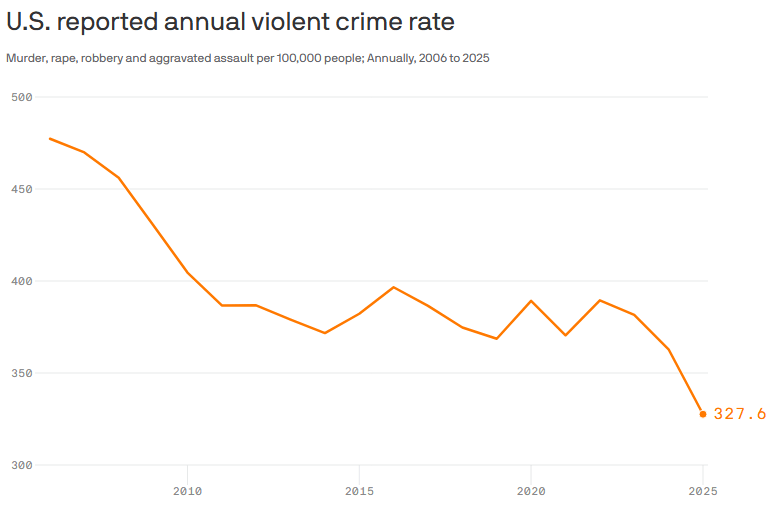
A bit of positive news. In the past 12 months, we’ve seen:

  • the largest decline in US murder rate ever recorded
  • huge declines in traffic fatalities and drug overdoses
  • a surprising (and largely unreported) decline in teen anxiety and despair, coinciding with ongoing declines in suicide
  • continued advances in GLP-1 medicines that seem to reduce obesity, inflammation, cardiovascular disease, and other illnesses that are currently under study

__________________________
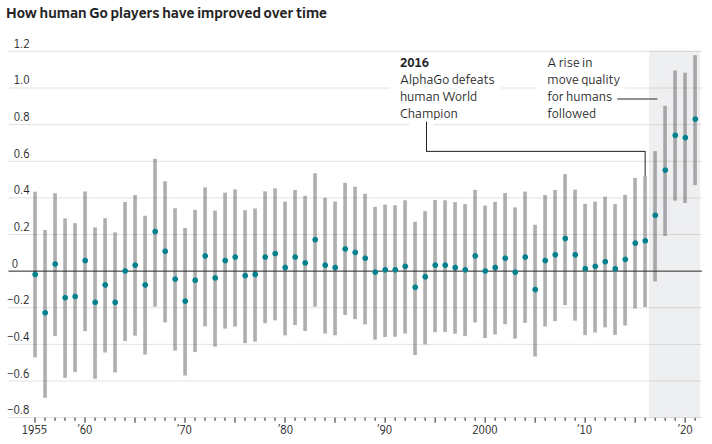
Baseball umpires have improved dramatically. The heat maps below show the evolution of the MLB strike zone from 2007 to 2025. The zone has changed dramatically, going from vibes to nearly matching the rule book definition perfectly.

________________________________
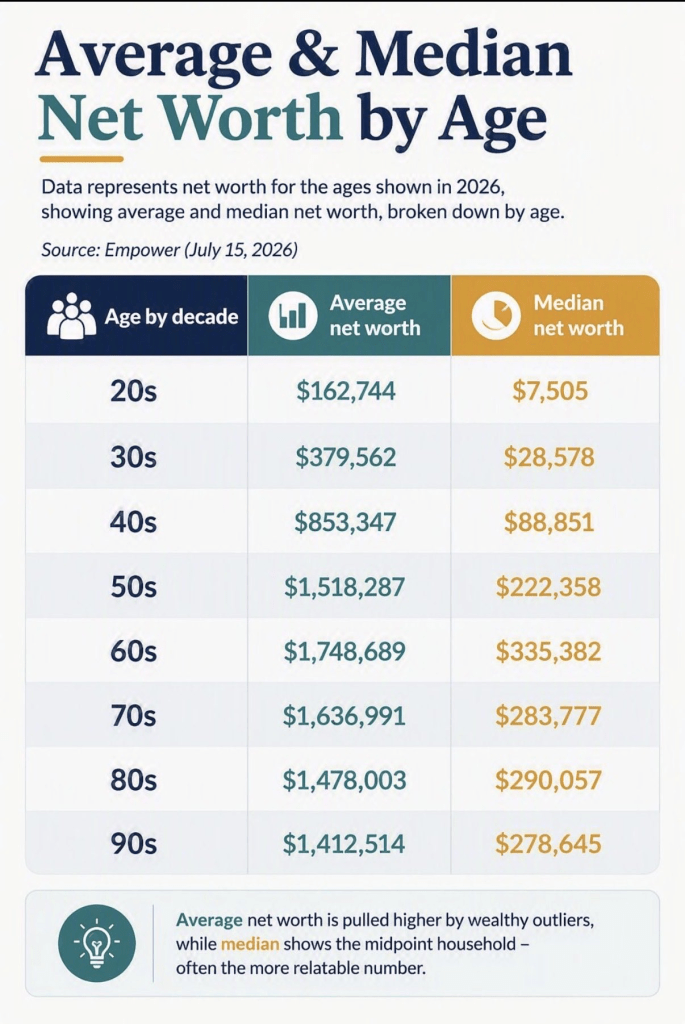
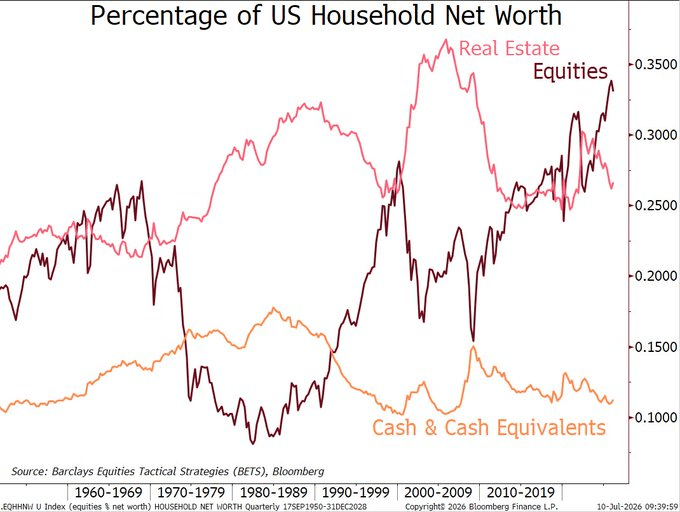
The truth about millionaires in America:

-Half have less than $2 million in net worth (and less than $340,000 in liquid assets)
-Most are NOT business owners
-Almost all are house/401k rich but cash poor

________________________________

About 90% of all outstanding bonds in the world yield lower than 5%:

________________________________
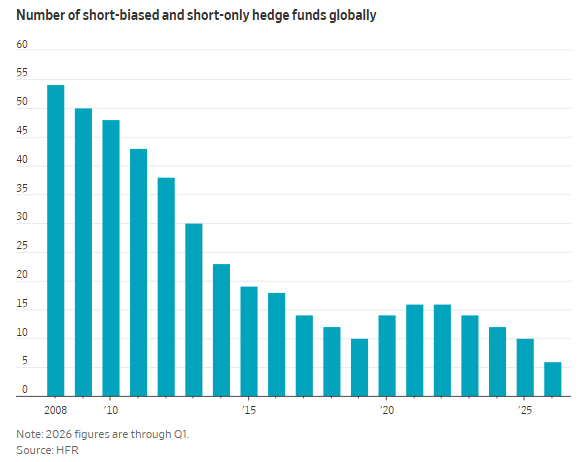
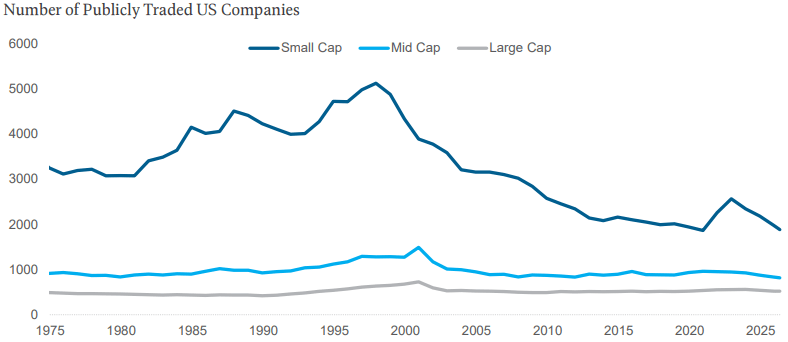
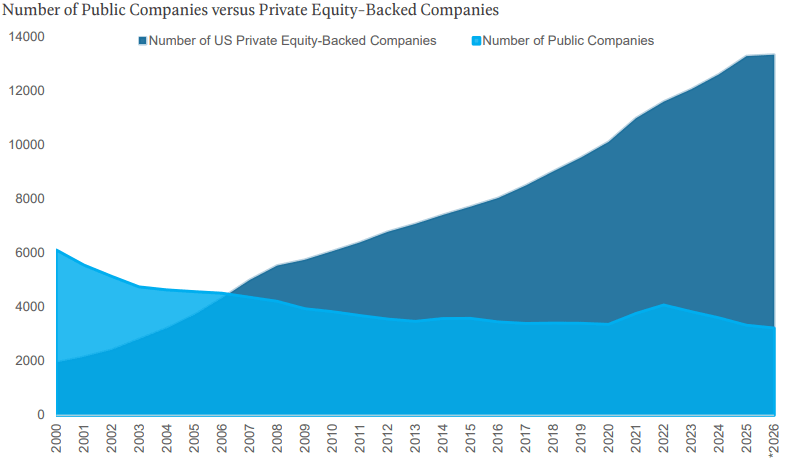
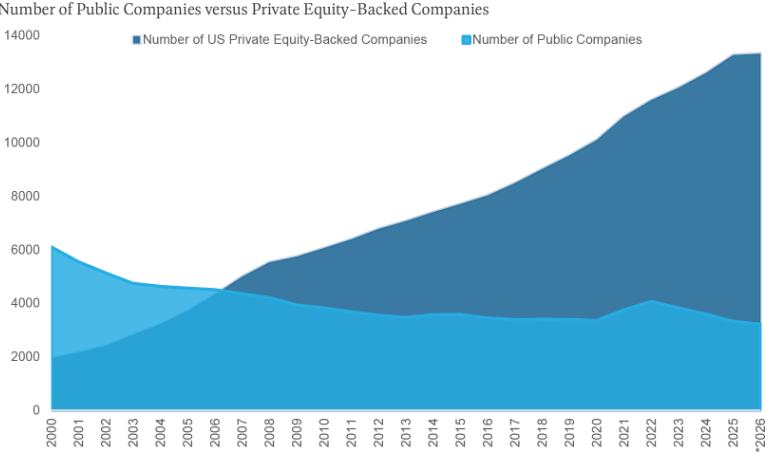
The falling number of public companies/stocks available to buy is a global phenomenon:

________________________________
After the Global Financial Crisis (GFC), the P/E ratio for US stocks was similar to that of the rest of the world, but the surge in tech valuations has now pushed the US P/E ratio 40% higher:

_______________________________
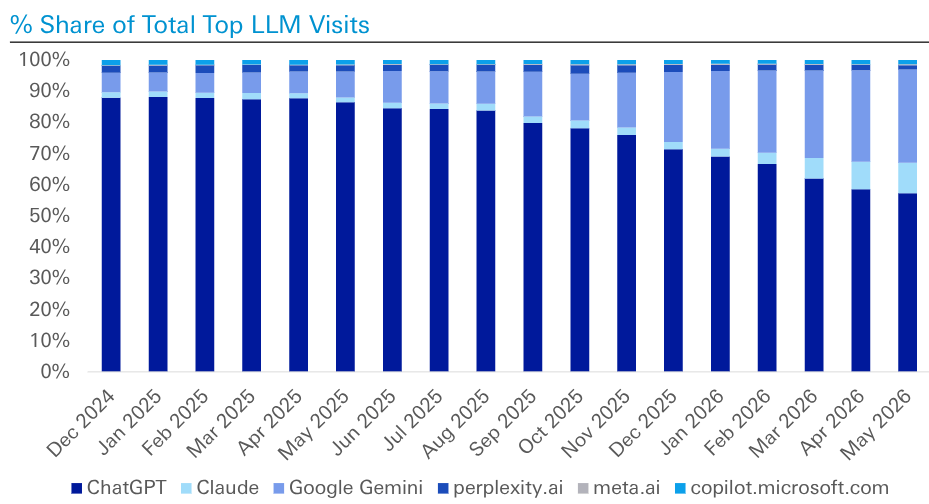
What software companies are in more danger vs. more safe from the relentless A.I. disruption:

🔴 High danger — “Search layer” companies: Companies whose main value is making publicly available data easier to search through a fancy interface. This includes financial data terminals built on licensed exchange data, legal research platforms built on public court records, and patent search tools. Many have already lost 40–60% of their value.

🟡 Medium danger — “Mixed portfolio” companies: Companies that have some proprietary assets but also rely on repackaging public information. The key question is: what percentage of their revenue comes from things AI can’t replace? (Think S&P Global — their credit ratings are safe, but their data analytics tools are exposed.)

🟢 Safer companies have one or more of these shields:

  • They own data nobody else can get — Bloomberg’s real-time trading desk data, S&P’s credit ratings, Dun & Bradstreet’s business credit files. AI actually makes this more valuable since every AI agent needs it.
  • They’re protected by regulations — Epic (hospital software) is shielded by HIPAA rules and FDA certifications. AI doesn’t change those requirements.
  • They’re embedded in money flows — If your software processes payments or settles trades (like Stripe), AI sits on top of you, not instead of you.
  • They have network effects — Bloomberg’s chat system works because everyone on Wall Street is on it. AI doesn’t change that.

China, Value, & Something Big That’s Happening

For years, AI had been improving steadily. Big jumps here and there, but each big jump was spaced out enough that you could absorb them as they came. Then, on February 5th, two major AI labs released new models on the same day: GPT-5.3 Codex from OpenAI, and Opus 4.6 from Anthropic (the makers of Claude, one of the main competitors to ChatGPT).

These new AI models aren’t incremental improvements. This is a different thing entirely. And here’s why this matters to you, even if you don’t work in tech.

The AI labs made a deliberate choice. They focused on making AI great at writing code first… because building AI requires a lot of code. If AI can write that code, it can help build the next version of itself. A smarter version, which writes better code, which builds an even smarter version. Making AI great at coding was the strategy that unlocks everything else. That’s why they did it first.

And now they’re moving on to everything else.

The experience that tech workers have had over the past year, of watching AI go from “helpful tool” to “does my job better than I do”, is the experience everyone else is about to have. Law, finance, medicine, accounting, consulting, writing, design, analysis, customer service. 

AI is now intelligent enough to meaningfully contribute to its own improvement. It’s now building itself. Dario Amodei, the CEO of Anthropic, says AI is now writing “much of the code” at his company, and that the feedback loop between current AI and next-generation AI is “gathering steam month by month.” He says we may be “only 1–2 years away from a point where the current generation of AI autonomously builds the next.”

Each generation helps build the next, which is smarter, which builds the next faster, which is smarter still. 

This is different from every previous wave of automation. AI isn’t replacing one specific skill. It’s a general substitute for cognitive work. It gets better at everything simultaneously. When factories automated, a displaced worker could retrain as an office worker. When the internet disrupted retail, workers moved into logistics or services. But AI doesn’t leave a convenient gap to move into. Whatever you retrain for, it’s improving at that too.

Nothing that can be done on a computer is safe in the medium term. If your job happens on a screen (if the core of what you do is reading, writing, analyzing, deciding, communicating through a keyboard) then AI is coming for significant parts of it. The timeline isn’t “someday.” It’s already started.

Eventually, robots will handle physical work too.

___________________________

In 2007, John Arnold became the youngest American billionaire, and he now focuses on philanthropy. He recently visited China and posted some of his thoughts:

  • The speed to add manufacturing capacity is stunning. Permitting takes weeks. A factory making sophisticated equipment is built in 12 months. An auto plant took 16 months from groundbreaking to first production. Slack in labor market makes it easy to staff and flex employment.
  • The US and China have significantly decoupled since early 2020. The # of flights between the two countries is down roughly 70%. Two long-term residents I spoke with said the # of American expats is down 50-75% from the peak. The # of Americans studying in China is down ≈90%.
  • Universities and government research labs are at least as tightly woven into the startup ecosystem as in the US, and in many cases more so. Their mission and incentive structures explicitly include commercialization, not just research.
  • China awards 1.3 million engineering undergraduate degrees each year vs 130,000 in the US.
  • Intense competition leads to widespread overcapacity and low profitability across many industries. Once an industry is deemed strategic, provincial governments deploy subsidies and other supports as they compete to turn local firms into hubs and capture the associated jobs.
  • I don’t know if Chinese manufacturers will ever make money but I came away not wanting to invest in any manufacturing business in the rest of the world.
  • You see American fast food everywhere. There are 12k KFCs (vs 4k in the US), 6k McDonalds, 7k Starbucks, 4k Pizza Huts.
  • Tier 2-4 cities are very quiet. Few cars on the road. Don’t see many people. Factory workers live in dorms on campus. Other workers are in gated compounds that are self-contained neighborhoods. Food delivery and e-commerce have replaced dining out and shopping.
  • China is one of only handful of countries with highly educated workforce, robust access to capital, and strong entrepreneurial culture. Only the US and China meet those conditions and have scale.
  • As industries become more complex, scale matters more than ever. Large countries can fund frontier R&D, support dense talent markets, amortize infrastructure, and create robust supply chains. Few countries can be cost competitive in high value-add manufacturing.
  • While the supply chain on transmission and grid infrastructure is backed up in the US, there is spare capacity in China.
  • A security check including bag x-ray is required to enter subway stations, at least in major cities. It’s interesting that most Western countries that are more dangerous do not do this, presumably for speed and cost.
  • There were fewer cranes than I expected, presumably reflecting the collapse of China’s real estate market.
  • Lower density cities still had most housing in high-rise residential buildings, usually built in complexes of 10-50 identical buildings. I guess it’s the most practical way to house people in a city growing quickly but the aesthetic damage is real.
  • Robotic coffee shops are taking off in China first even though wages are much higher in the US.

_____________________________
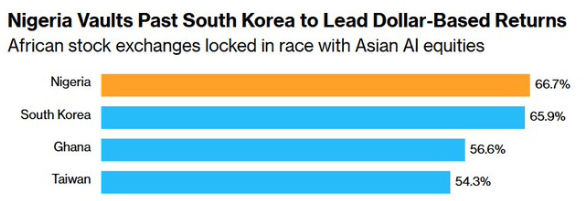
The Yale model, investing in private companies, worked in the ’80s and ’90s for one simple reason — there wasn’t a tidal wave of capital chasing deals. Buyouts were done at reasonable entry prices.

Today, small and mid-size businesses are being acquired at sky-high valuations, often with little margin for error. High entry prices make outsized returns harder to achieve (even with leverage, even with financial engineering).

____________________________
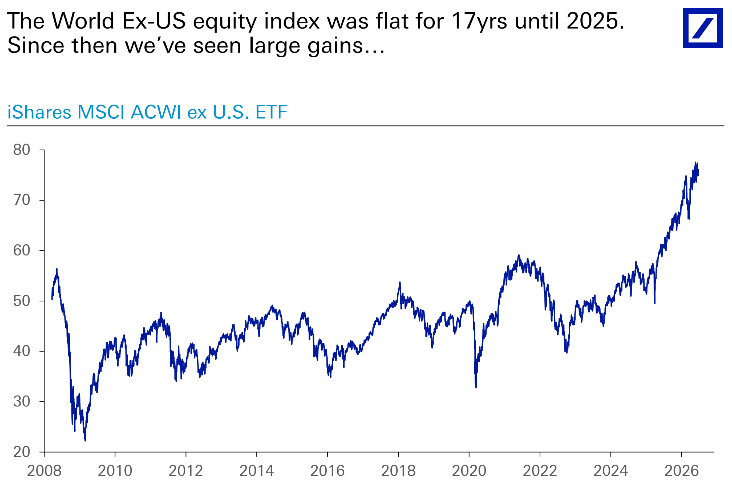
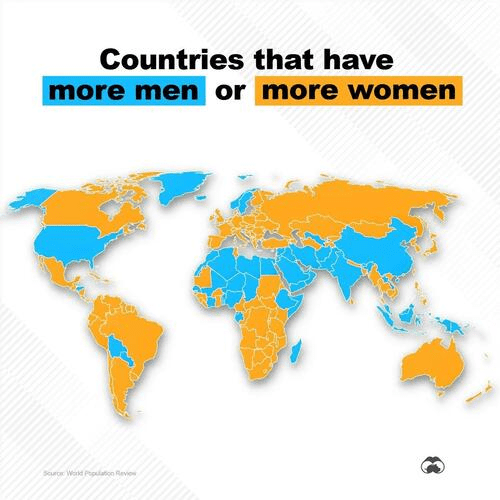
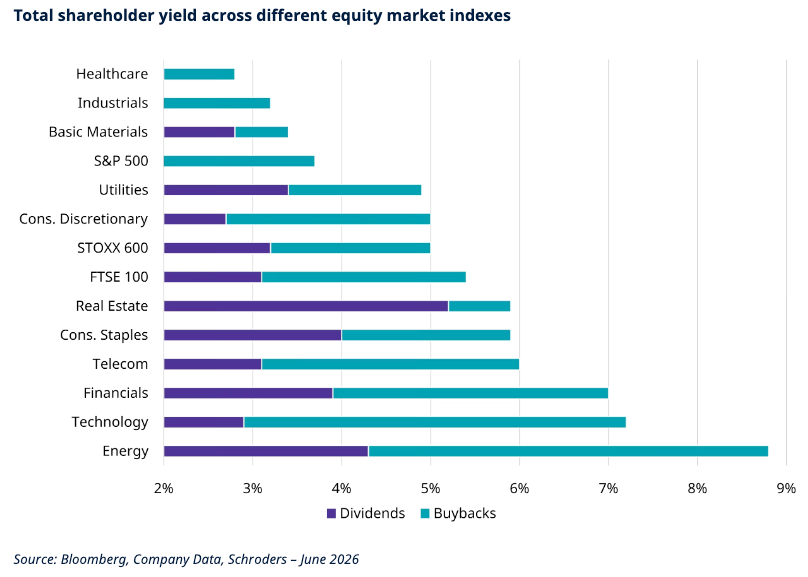
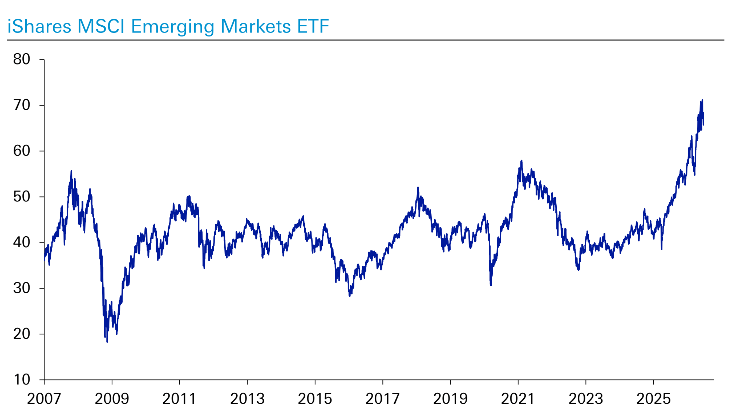
Europe and Emerging Market countries have not embraced stock buybacks, yet.

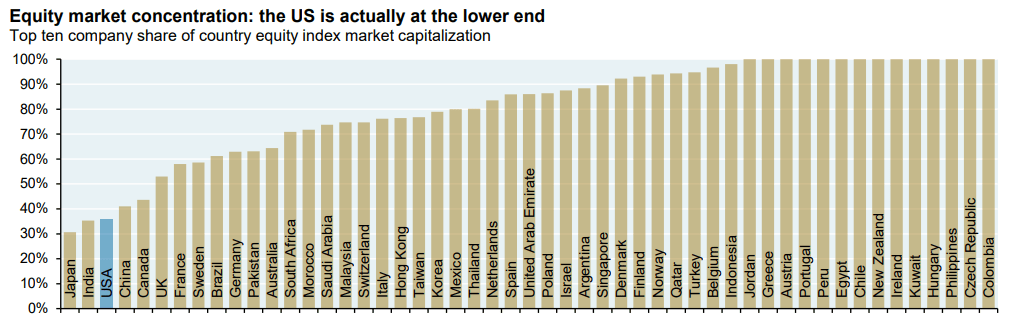
Market concentration for the largest stocks is everywhere in the world, not just the United States:

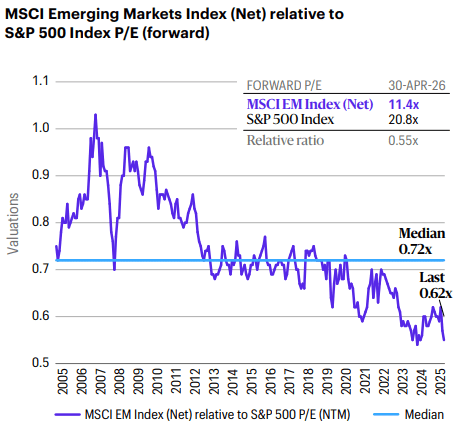
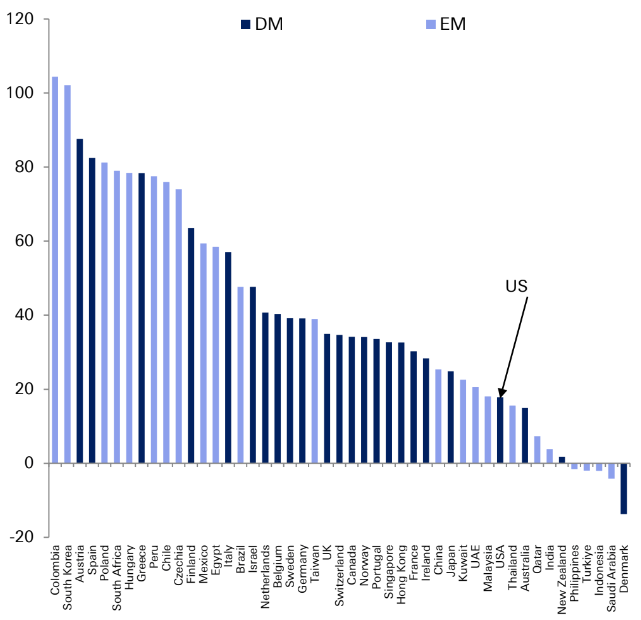
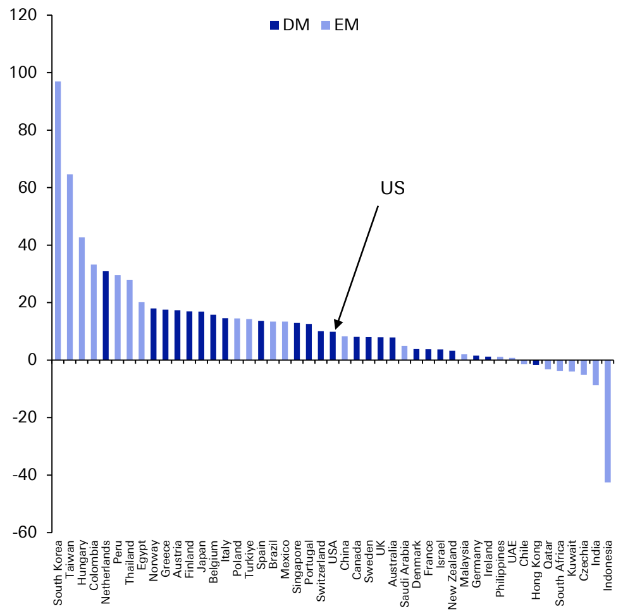
U.S. valuations are still well above the rest of the world, even as the rest of the world outperformed the U.S. in 2025:

The CAPE ratio of the U.S. vs. the rest of the world:

Most emerging market countries are still extremely cheap, but some have moved into the more expensive red zone:

Within the United States, it’s the large cap stocks that are extremely expensive:

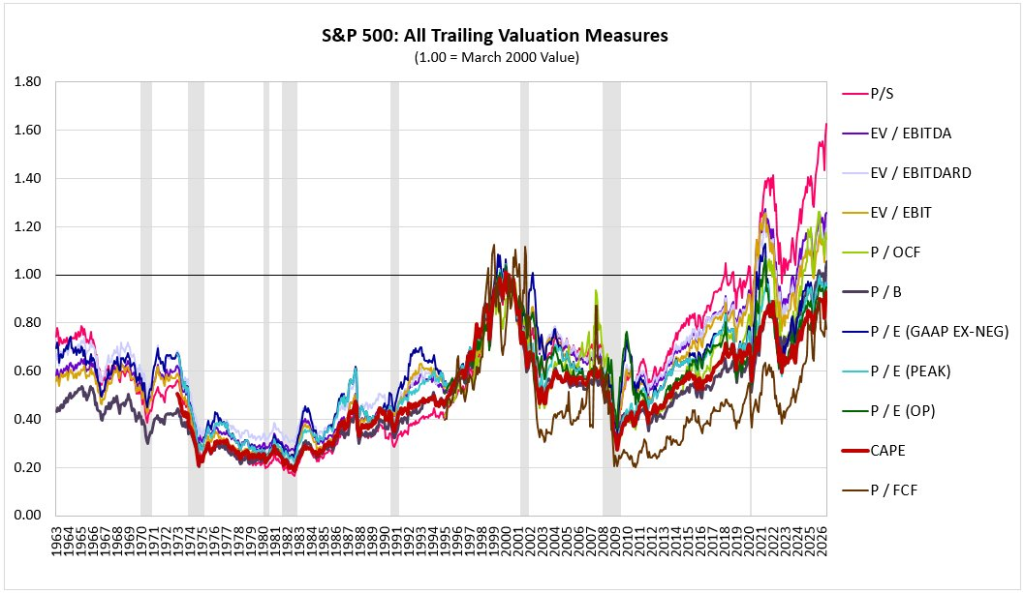
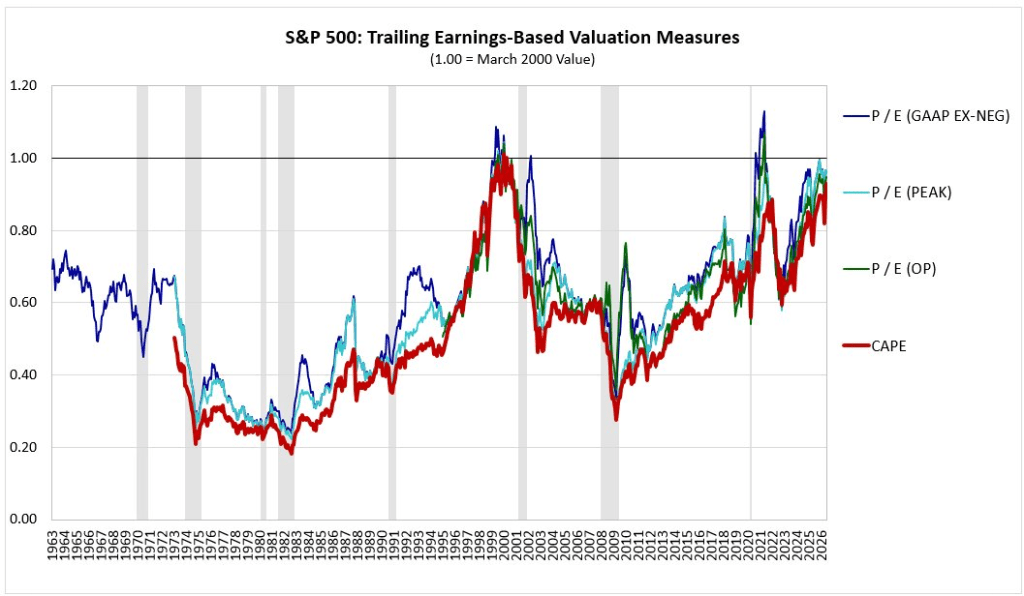
Another valuation metric in historical comparison:

Bowling Alone, Happiness & Pulling The Goalie

Statistically, if you’re down by two goals in hockey, you should be pulling the goalie with something like eight minutes left, not with a minute and a half. But if you do that and the other team scores two empty-netters, you look like an idiot. Right now, they pull with 90 seconds left, and if they lose, everyone says, ‘Well, you had to try.’ You pull with five minutes left and lose 5–1 and the announcers say, ‘What the hell is this guy doing?’ These hockey coaches, when they wait too long to pull the goalie and lose the game, they are choosing to be wrong rather than look wrong.

Max Greyserman is ranked No. 33 in the world, not a star but tantalizingly close. In his rookie season of 2024, his average score over 18 holes was 69.998; if he had improved that by .085 — or less than one-tenth of a stroke per round — he would have passed Rory McIlroy and cracked the top five on the tour. It’s not a perfect comparison; McIlroy played some harder courses. But it’s an indicator of how scarily slim the margins are in pro golf — in both directions.

All it takes to slip back into the middle of the pack, maybe even to lose your tour card, is a string of small errors made under pressure, plus some bad luck. Success in golf rides on physical skill, of course, but the closer you get to the top, the more it becomes about intangibles, like the ability to deal with these hairsplitting variations in performance and not lose your grip on probabilities.

That’s why I became interested in Max and ended up out there at Pebble Beach talking to his dad about pulling the goalie. What sounded at first like a digression turned out to be more of a nudge: This is how to watch sports. Don’t get stuck on outcomes. Avoid the knee-jerk determination of good or bad. Look for the patterns, the process, the decision-making, the mind-set, the systems for dealing with risk. This is how sports can actually reveal something to you about human nature.

_______________________________
Douglas MacArthur was the American general who commanded Allied forces in the Pacific during World War II and later ran occupied Japan. William Manchester, in his biography of MacArthur, mentioned how in 1950, when MacArthur was in Tokyo, he read exactly five newspapers every morning. What’s unusual was that these newspapers were all at least three days old. His staff thought he was losing it. Why would the Supreme Commander want stale news when fresh news arrived by the hour?

MacArthur’s reasoning was simple. Three days gave the initial panic time to settle. It let him see which stories actually stuck around and which ones everyone had already forgotten about. For him, this delay acted as a filter because it cut out all noise and what remained, if anything, was a signal.

Nassim Taleb once wrote: “To be completely cured of newspapers, spend a year reading the previous week’s newspapers.”

This is such a powerful thought. Most of what passes for urgent news has zero shelf life. Even if you read it a week later, you’ll see how little of it actually mattered. Taleb was talking about newspapers, but the principle applies even more to social media, where information decays not in weeks but in hours.

Our brains aren’t good at sorting the flood of information in real time. Every piece of information, regardless of quality, takes up mental real estate. It doesn’t matter if it’s valuable or garbage, it still occupies space in your head.

Most investment mistakes aren’t failures of information. They’re failures of judgment. You had the information, like everyone did. But you misjudged what it meant because you were processing it in a rush, surrounded by other people’s opinions.

You do need to stay informed about the businesses you own and the industries you follow. The question is: what’s the minimum effective dose of information? For most investors, that ratio is way lower than they think. You probably need about 10% of the information you’re currently consuming. Maybe less. The rest is entertainment dressed up as education.

____________________________
It’s tempting to believe that smartphones and social media were introduced to an ideal society and ruined everything. But the social problems we face today — while linked to contemporary digital technologies — are deeper and more nuanced than that. They originated from 20th century technological and cultural forces that also brought extraordinary benefits.

Starting in the 1950s, America underwent a wave of changes that looked like unalloyed progress. The 1956 Federal Highway Act funded 41,000 miles of interstate, opening up a suburban frontier where families could afford their own homes with yards, driveways, and privacy. Women entered the workforce en masse, expanding freedom and equality and adding to household incomes. The television — which provided cheap, effortless entertainment — was adopted faster than any technology in history, from 10% of homes in 1950 to 90% by 1959, according to Putnam. Air conditioning made homes comfortable year-round. Shopping migrated from Main Street to climate-controlled malls with better prices and wider selection.

These changes were widely embraced because they made life better for millions of people in countless ways. But they quietly eroded community, shifting American life toward comfort, privacy, and control, and away from the places and habits that had held communities together.

Suburbs scattered neighbors across cul-de-sacs designed for privacy over casual interaction. The front porch — where you might wave to a neighbor and end up talking for an hour — gave way to the private backyard deck and the two-car garage. Television privatized entertainment, moving what once happened in theaters, dance halls, and community centers into living rooms where, by the 1990s, the average American adult was watching almost four hours a day, and, Putnam tells us, half of adults usually watched alone. Dual incomes often meant neither parent had time for the PTA meeting or volunteer shift. Local shops on main street closed because they couldn’t compete with the mall.

Generation by generation, the habits of connection weakened while the scope of everyday comfort, privacy, and control grew. Then came the digital revolution — with the internet and smartphones — and these isolating forces accelerated.

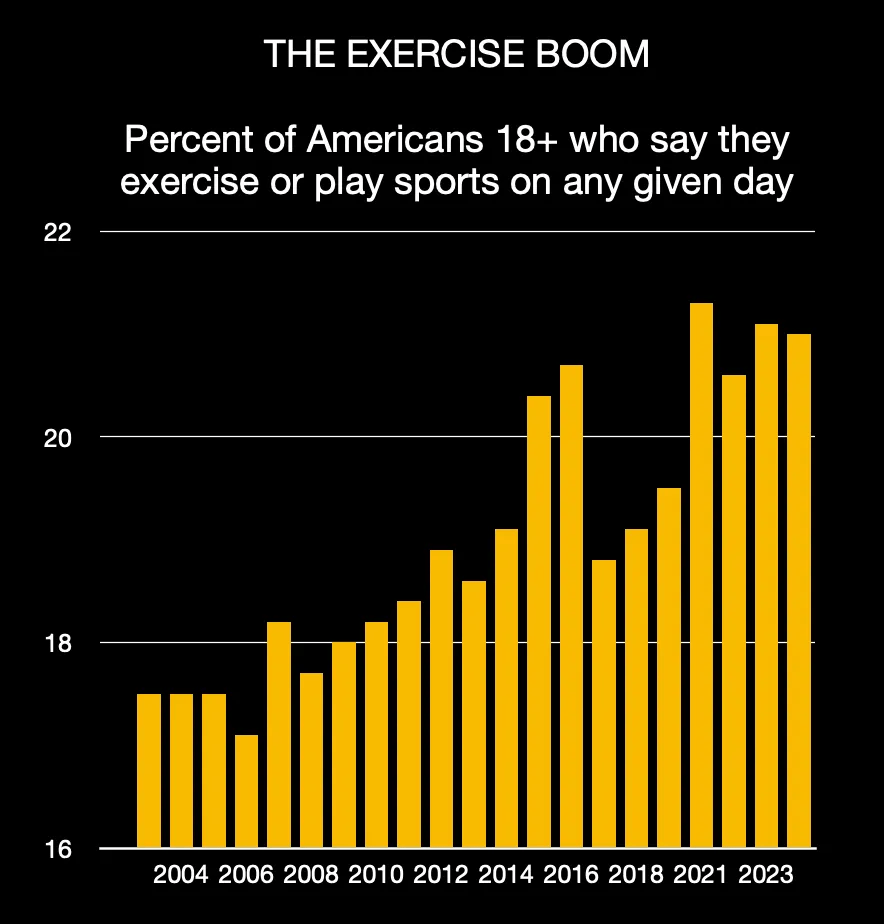
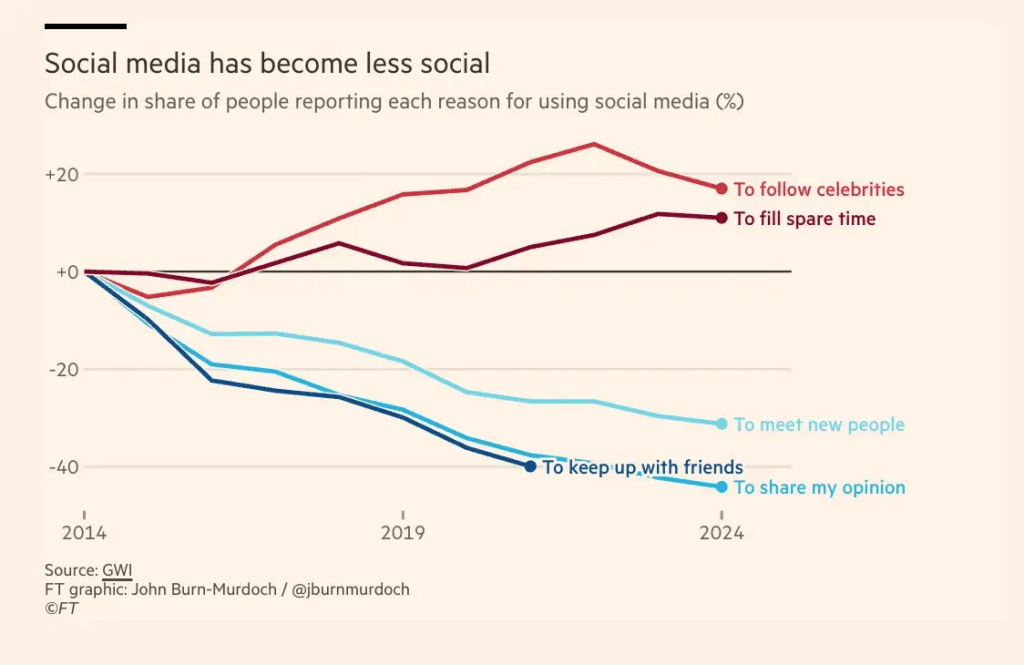
Digital technology extends the logic of suburban sprawl: it allows us to live not just physically apart, but entirely in parallel. In the past decade, e-commerce jumped from 7% to 16% of retail while physical stores shuttered. Online grocery sales are growing 28% year over year. Home exercise has surged in popularity. Twenty-eight percent of Americans work from home, up from just 8% in 2019. Across every sphere — shopping, working, exercising, socializing — we’re choosing staying in over going out because we enjoy the privacy and convenience.

Meanwhile productivity technologies are dissolving the boundaries between work and personal life. While work used to have clear boundaries, today, for knowledge workers in particular, a laptop and Wi-Fi mean the office never closes. Work bleeds into every hour, every room. When you can always be earning, social commitments become harder to justify.

________________________________
In what’s now known as the Easterlin paradox, wealthier individuals report greater happiness at any given moment, but average happiness does not rise as societies get richer.

Our long-held belief that money can’t buy happiness appeared to be validated by research suggesting happiness plateaued around $75,000 a year. Further research found something more nuanced: happiness rose with income up to about $100,000 — and then leveled off. For others, happiness continued to rise. And for the happiest group, it even accelerated.

If you become rich, you’re still the same you but just richer. Wealth can offer many blessings, but it can’t exorcise any demons. I imagine it like arriving at a tropical getaway only to discover you can’t take off your winter coat — sealed tight by past experiences, trauma or misplaced expectations.

_________________________
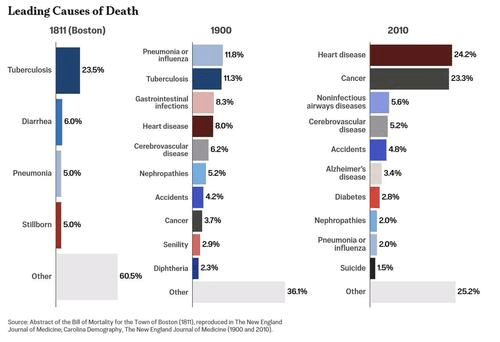
Life expectancy in the U.S. reached a record high in 2024, according to figures released by the federal government this week.

Heart disease, cancer and unintentional injuries remained the top-three leading causes of deaths. Drug overdose deaths decreased by more than 26% between 2023 and 2024, marking the largest year-to-year drop in those types of fatalities recorded by the federal government.

The Hidden Private Equity Losses In Life Insurance Companies

Whitney Baker at Totem Macro penned an excellent thread this week discussing where the losses are hidden in Private Equity. I asked Claude to summarize the thread and provide additional information where needed:

Private equity (PE) firms have been buying up about 10% of US life insurance companies since 2020. They’re then using the insurance companies’ money (called the “float” – money from premiums that hasn’t been paid out yet) to make risky loans to struggling businesses.

They’re using a private ratings agency to label these risky loans as safer than they actually are. This fake safety rating lets them:

  • Hold less cash in reserve (normally you need more reserves for risky investments)
  • Legally invest in things they otherwise couldn’t

Many of these loans are going bad – about 10% are already defaulting. The companies that borrowed the money are often unprofitable startups (especially software companies) that can’t actually pay back their debts. Some are even “zombie companies” kept alive artificially.

How the Fed raising rates in 2023 amplified this problem:

  1. Fed Raises Rates → Government Borrowing Costs Go Up
    • When the Fed raised interest rates, it became more expensive for the US government to borrow money
    • The government pays interest on its debt, so higher rates mean higher interest payments
    • This caused the government’s budget deficit to balloon by 3% of GDP in 2023
  2. Bigger Deficit → More Treasury Bonds Issued
    • To cover this bigger deficit, the government had to issue more Treasury bonds
    • These bonds became “fresh collateral” – basically, new assets that could be used as backing for loans
  3. The RRP Money Gets Unlocked
    • There was $2.5 trillion sitting in something called the Fed’s “Reverse Repo Program” (RRP) – think of it as a parking lot for cash
    • Normally this money just sits there safely
    • But with all these new Treasury bonds available, financial institutions could use them to borrow against in “repo markets” (short-term lending markets)
  4. PE Firms Borrow This Money
    • The private equity firms and their various entities (the “layers of the leverage cake”) were able to tap into this massive pool of money
    • They used it to fund more and more risky loans through the insurance companies

Instead of letting the economy cool down (which is what rate hikes are supposed to do), the Fed accidentally created a situation where trillions of dollars flowed into this problematic private equity scheme.

Who Gets Hurt: Foreign banks and insurance companies:

  1. Foreign Institutions Bought the Debt
    • These PE firms and BDCs (Business Development Companies – investment funds that make these risky loans) didn’t just use insurance company money
    • They also borrowed money from banks and sold bonds/securities to investors
    • Foreign banks and insurance companies in countries like Japan and Germany were major buyers of these securities
  2. Why Foreign Buyers?
    • Japanese and German institutions are from “surplus creditor nations” – countries that save a lot and invest globally
    • They’re always looking for places to invest their money
    • US securities seemed attractive, especially ones with good (fake) credit ratings
  3. They’re Holding the Bad Loans
    • When these loans start defaulting (which the author says is already happening at 10%+), the value of those securities plummets
    • The foreign banks and insurers who bought them will take massive losses
  4. They Don’t Know Yet
    • Stocks of these foreign financial institutions are “at all time highs”
    • Meanwhile, US-listed PE firms and BDCs have already collapsed in value
    • This suggests the foreign institutions haven’t realized their investments are worthless yet – the losses are hidden in complex financial structures

Foreign banks and insurers thought they were buying safe, well-rated US investments. Instead, they’re holding bags of loans to failing startups and zombie companies. When they finally discover this (mark their books to reality), their stock prices will crash too. It’s like they bought what they thought were AAA-rated bonds, but they’re actually subprime loans in disguise.

In Summary: This is as a massive, ticking time bomb of bad debt hidden inside insurance companies, enabled by sketchy ratings and Fed policy.

Attention, Airlines & Mobile Games

Everyone knows it’s hard to get college students to do the reading—remember books? But the attention-span crisis is not limited to the written word. Professors are now finding that they can’t even get film students—film students—to sit through movies.

I heard similar observations from 20 film-studies professors around the country. They told me that over the past decade, and particularly since the pandemic, students have struggled to pay attention to feature-length films.

A professor at the University of Southern California, home to perhaps the top film program in the country, said that his students remind him of nicotine addicts going through withdrawal during screenings: The longer they go without checking their phone, the more they fidget. Eventually, they give in.

He recently screened the 1974 Francis Ford Coppola classic The Conversation. At the outset, he told students that even if they ignored parts of the film, they needed to watch the famously essential and prophetic final scene. Even that request proved too much for some of the class. When the scene played, the professor noticed several students were staring at their phones.

Professors at Universities can track whether students watched films on the campus internal streaming platform. Fewer than 50 percent would even start the movies, he said, and only about 20 percent made it to the end. (Recall that these are students who chose to take a film class.)

After watching movies distractedly, if they watch them at all, students unsurprisingly can’t answer basic questions about what they saw. When a film professor at UW Madison asks what happens at the end of a film, more than half of the class picks one of the wrong options.

The professors I spoke with didn’t blame students for their shortcomings; they focused instead on how media diets have changed. From 1997 to 2014, screen time for children under age 2 doubled. And the screen in question, once a television, is now more likely to be a tablet or a smartphone. Students arriving in college today have no memory of a world before the infinite scroll. As teenagers, they spent nearly five hours a day on social media, with much of that time used for flicking from one short-form video to the next. An analysis of people’s attention while working on a computer found that they now switch between tabs or apps every 47 seconds.

A film and media-studies professor at Johns Hopkins, usually begins his course with an icebreaker: “What’s a movie you watched recently?” In the past few years, some students have struggled to name any film.  A performing- and media-arts professor at Cornell University, has noticed a similar trend. Some of her students arrive having seen only Disney movies. 

Of course, young people haven’t given up on movies altogether. But the feature films that they do watch now tend to be engineered to cater to their attentional deficit. In a recent appearance on The Joe Rogan Experience, Matt Damon, the star of many movies that college students may not have seen, said that Netflix has started encouraging filmmakers to put action sequences in the first five minutes of a film to get viewers hooked. And just because young people are streaming movies, it doesn’t mean they’re paying attention. When they sit down to watch, many are browsing social media on a second screen. Netflix has accordingly advised directors to have characters repeat the plot three or four times so that multitasking audiences can keep up with what’s happening.

___________________________

___________________________
We rank nine major U.S. airlines on seven equally weighted operations metrics:

  • on-time arrivals
  • flight cancellations
  • delays of 45 minutes or more
  • baggage handling
  • tarmac delays
  • involuntary bumping
  • passenger submissions (which are mostly complaints)

____________________________
To keep people splurging in mobile games on your phone like the Custom Street Racing, FarmVille and Words With Friends franchises, their publisher, Zynga, uses a secretive V.I.P. program that treats players like royalty. It is a tactic borrowed from casinos, which may offer a free meal or show tickets when they notice a player is losing more than usual on a slot machine.

Retaining big spenders is essential in the competitive world of mobile gaming, where roughly 90 percent of revenue can come from less than 5 percent of the player base.

The typical V.I.P. gamer is a retired or semiretired professional drawn in by the chance to meet new people online. The continuous stream of updates and seasonal features in mobile games can also create a feeling of purpose and productivity. They can choose to spend their surplus income on golf memberships or they can play FarmVille with their newfound friends in Australia for the weekend.

Players who pour hundreds or thousands of dollars into a game are known as whales, a term borrowed from the gambling world that many people in the industry avoid.

Preventing burnout was a key goal when casinos introduced V.I.P. programs. Harrah’s influential program, which began in 1997, used a digital tracking tool to detect when someone was losing more often than a slot machine’s predetermined odds. To stop players from forming a negative memory that might dissuade them from coming back, an alert would instruct a casino floor attendant to approach them with a reward.

Similar programs are becoming widespread in the video game industry as companies invest in free-to-play and live service games.

____________________________
For decades, researchers have noted that cancer and Alzheimer’s disease are rarely found in the same person, fuelling speculation that one condition might offer some degree of protection from the other.

Now, a study in mice provides a possible molecular solution to the medical mystery: a protein produced by cancer cells seems to infiltrate the brain, where it helps to break apart clumps of misfolded proteins that are often associated with Alzheimer’s disease. The study was 15 years in the making and could help researchers to design drugs to treat Alzheimer’s disease.

____________________________________
Colon cancer is now the leading cause of cancer death in the U.S. for those under 50. Medical groups have lowered the recommended age for colonoscopies that can detect the disease while there are good odds for effective treatment.

_____________________________________
The Zone Of Scarcity & Global Developments

Vikram Mansharamani published his global developments to watch from 2026 to 2031. These were a few that I found interesting:

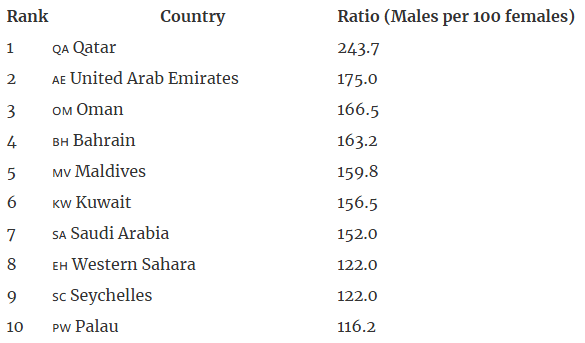
  • Bio-fabrication technologies advance rapidly enabling human organs to be printed on demand. A new industry of “body mechanics” emerges and utilizes AI-driven prediction models to pre-emptively replace joints, bones, and organs before they fail. The expected lifespan of a child born in 2030 rises to 151 years.
  •  Advancements in quantum computing lead to a geopolitical crisis as all formerly- secure communications become instantaneously vulnerable. Each breakthrough leads to a bump in gold prices as investors fear the possibility of quantum-enabled theft of cryptocurrency. Cybersecurity re-emerges as an area of top concern for corporate boardrooms, nation states, and individuals.
  • Deepfake technologies become indistinguishable from real life, leading to mass human confusion and cognitive dissonance. Reality Defender emerges as the world’s hottest company as it secures elections by providing voters assurance of authentic messaging from candidates, thereby saving democracy from being hijacked by technologically-savvy foreign actors.
  •  A boom in next generation nuclear technologies combines with improved hydrocarbon extraction efficiency to keep energy prices contained in the face of exploding demand from technology applications and data centers. As copper emerges as the world’s most strategic resource, the Great Powers shift their focus from the Middle East to the Andean region.
  • The insatiable consumer appetite for protein continues indefinitely. Restaurants start disclosing the protein content of menu items, and Coke introduces a high-protein soda. Public health deteriorates as Americans’ religious focus on protein leads to elevated consumption of sugars and artificial sweeteners.
  • The global use of GLP-1 drugs skyrockets as an oral pill becomes readily available and is covered by most health insurance plans or government health offices. 
  • Artificial intelligence generates deflation, leading to structurally rising unemployment and elevated debt levels.

___________________________________
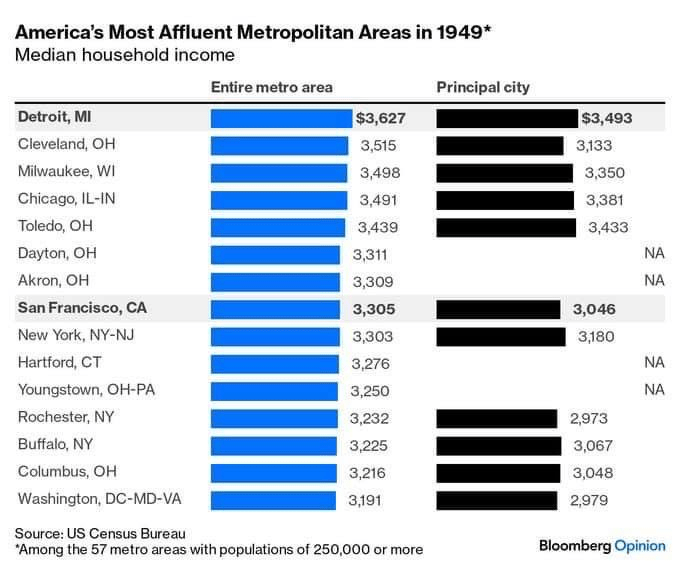
We are drowning in information and data. So much so that we’re obese in the mind. The same way the human body was not prepared for a world of abundant food, and we thus transformed our cities into feeding zones full of fat people, the human mind is not prepared for a world with infinite content and information. Less than two decades into social media and the world is already full of morbidly obese minds that cannot think or focus, let alone produce anything novel anymore.

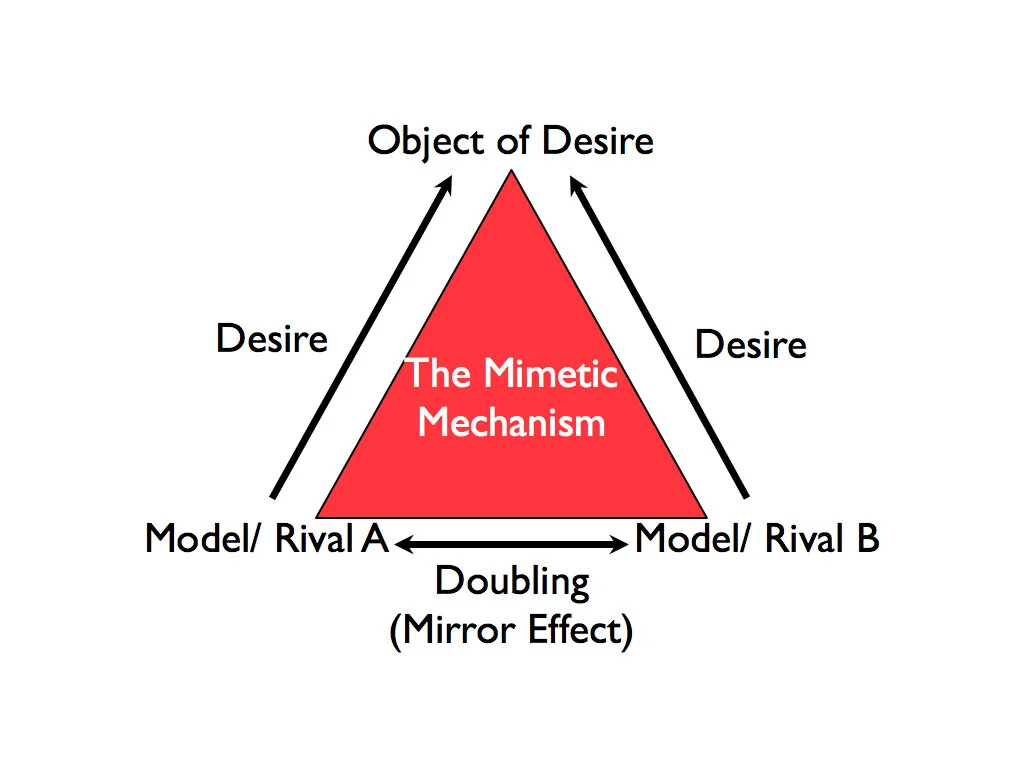
Even the best of us are mentally overweight! There are few, if any, original ideas anywhere. Everyone, everywhere is in a constant, social-media induced mimetic trance, mistaking repetition for thought while parroting the same words as those in our little echo chamber.

The only solution is to shut it all out. I’ve come to the realization that selective ignorance on the other hand; I’m talking actual willful, intentional ignorance, is not only blissful, but is a holy virtue.

It’s the kind of ignorance that is deliberately oblivious to what is going on in the world because none of it matters an iota in the grand scheme of one’s life. It’s the kind of noble, savage and ruthless ignorance that doesn’t even waste energy saying: “I don’t care.” It’s just blissfully above to the noise, present only with what matters, here and now.

As the pace of things accelerates and the never ending cycle of hysteria continues, it’s dawned on me that none of it really matters. Sure, individual events may matter to some people, but because of how we’re wired and how the internet and social media have connected us all, the number of events that can (a) happen and also (b) be brought to our attention is infinite.

Which in short means that everything matters all the time. But when everything matters all of the time, then the only reaction for the mind and body is to become numb. In other words, nothing means anything or matters any more. This is not a way to live.

Attention, at the end of the day, is all we really have. It’s finite. It’s super super super finite. We have so little time. We have only so much energy. It’s hard to focus at the best of times, and here we are, on a daily basis, being either:

  1. Distracted by things inside of a phone-size shopfront that most of us will either never have (picture-perfect women, hotels, cars, etc), or
  2. Inflamed by things on that same stupid screen which we have no relationship to or influence over, happening in other parts of the world, thousands of miles away.

The end result of all this stupidity (for 99.9999% of people) is just a LOSS of attention. I’m sure some of you have found inspiration or motivation from these screens (this can happen), but if we’re all being TRULY honest with ourselves here, we can admit the truth: we can be just as inspired by a walk on the beach or a conversation with a loved one too.

When I’m on my deathbed, I won’t remember wtf I saw on Twitter or Instagram from all those endless hours of looking at the screen. But I will remember the time I spent with the people who I truly loved. To find a solution, one must first understand the problem, and the problem is twofold:

  1. Nobody is entirely immune to the siren call of dopamine. These platforms hack your biology in such a way that they hook you. Thus you are not fighting the platform, but your own biology – and this consumes energy. Energy that could be much better spent elsewhere.
  2. Our cups are already full. Those of use who are strong learners have already had our fill, especially if you’ve been online for the last 5 – 10 years. We’re well past the point of diminishing returns. We have all the information we could possibly need to live and lead meaningful lives. Stuffing our minds with more stuff won’t improve anything, and at this point is just a distraction from living in the real world and implementing the things we’ve already learned or know.

The beautiful thing about value is that it always migrates to the zone of greatest scarcity. As a zone attracts more attention (and thus value), it begins to lose scarcity, until it gets saturated, and then one day, the value migrates away to a zone where scarcity prevails. People are starting to realize that being online is quickly becoming uncouth and that they need to run away. But where?

The answer: offline. 

Death, Pessimism & Frontier Markets

Contemplating death is the New Year’s resolution to end all resolutions. Why? Because it sharpens our focus, allows us to clarify what truly matters—and to craft our goals and priorities around that—anchors us in the present moment, and deepens our appreciation for all that life has to offer, right here and now.

Remembering that we are going to die goes hand-in-hand with another key realization: we have no way of knowing how much time we have left. We might die in three years, or 38 years, or a few months from now. So, what should we do with the time we have—with our one wild and precious life?

Humans have long known of the power of this practice. We’ve been contemplating death for over 100,000 years, from the earliest archeological burial artifacts to Buddhist maraṇasati, from Stoic philosophy to ancient Egyptian funerary texts.

It’s only in the modern Western world that we began to see this practice as depressing or morbid. We lost our relationship with death, and somewhere along the way, we stopped living fully too.

Here are 11 science-backed benefits of taking the time to think about death:

  • Cut through your own bullshit – helps you overcome excuses and stop wasting time on what’s not serving you
  • Clarify your values – less bullshit = more clarity
  • Motivation to act – gives you permission to stop living on autopilot or within societal expectations and start living in alignment with what actually feels true
  • Find a deeper purpose – research shows that being reminded of our mortality triggers a psychological drive to seek or restore meaning in life.
  • Be more present – when you fully accept that everything, and I mean everything, will ultimately be taken from you, the present moment suddenly becomes sacred
  • Gratitude –  like anything else rare and precious, when we remember that life is fleeting, we value it more
  • Stronger relationships – when you remember that one day, everyone you love will die, and so will you, your relationships change
  • Empathy and compassion – death is the great equalizer
  • Unlocks creativity – gives rise to an intense drive to make your own little dent on the universe, to leave something behind to say that you were here. 
  • Keep your ego in check – it’s a reminder that you’re not the center of the universe, the desire to impress starts to dwindle, liberating you from feeling like you need to be the smartest, best, most admired person in the room – instead, you start to show up as a real person: flawed, fleeting, and free
  • Take more risks –  the only thing scarier than dying is never having really lived, so you’re more likely to pursue the life you’ve been dreaming of.

______________________________
Interest rates have begun to come down. Inflation has mostly subsided, and the real economy is still doing decently well.  So why are American consumers more pessimistic than they were during the depths of the Great Recession or the inflation of the late 1970s?

It’s possible to spin all sorts of ad hoc hypotheses about why consumer sentiment has diverged from its traditional determinants. Perhaps Americans are upset about social issues and politics, and expressing this as dissatisfaction about the economy. Perhaps they’re mad that Trump seems to be trying to hurt the economy. Perhaps they’re scared that AI will take their jobs. And so on.

Here’s another hypothesis: Maybe Americans are down in the dumps because their perception of the “good life” is being warped by TikTok and Instagram.

I’ve been reading for many years about how social media would make Americans unhappier by prompting them to engage in more frequent social comparisons. In the 2010s, as happiness plummeted among young people, the standard story was that Facebook and Instagram were shoving our friends’ happiest moments in our faces — their smiling babies, their beautiful weddings, their exciting vacations — and instilling a sense of envy and inadequacy.

However, note that during the 2010s, consumer confidence was high. Even if people were comparing their babies and vacations and boyfriends, this was not yet causing them to seethe with dissatisfaction over their material lifestyles. But social media today is very different than social media in the 2010s. It’s a lot more like television — young people nowadays spend very little time viewing content posted by their friends. Instead, they’re watching an algorithmic feed of strangers.

There were rich people like that in 1920, or 1960, or 1990. But you almost never saw them. Maybe you could read about them in People magazine or watch a TV show about them. But most people simply didn’t have contact with the super-rich. Now, thanks to social media, they do. 

But even more subtle might be the influencers who are merely upper class rather than spectacularly rich. These people aren’t living the lifestyle of a ultra-rich influencer, yet most of what you’re seeing in these photos and videos is economically out of reach for the average American. 

These are not obviously rich people — they’re more like the 5% or the 1% than the 0.01%. Their lifestyles are out of reach for most, but not obviously out of reach. Looking at any of their videos, you might unconsciously wonder “Why don’t I live like that?”.

Americans were always shown examples of aspirational lifestyles on TV shows. Yet on some level, Americans might have realized that that was fiction; when you see a lifestyle influencer on TikTok or Instagram, you feel like you’re seeing simple, bare-bones reality.

The rise of social media influencers has scrambled our social reference points. Humans have always compared ourselves to others, but before social media, we compared ourselves to the people around us — our coworkers, friends, family, and neighbors.

Those classic reference points tended to be people who were roughly similar to us in income — maybe a little higher, maybe a little lower, but usually not hugely different.

But perhaps even more importantly — we were able to explain the differences we saw. In 1995, if you knew a rich guy who owned a car dealership, you knew how he made his money. If you envied his big house and his nice car, you could tell yourself that he had those things because of hard work, natural ability, willingness to accept risk, and maybe luck. The “luck” part would rankle, but it was only one factor among many. And you knew that if you, too, opened a successful car dealership, you could have all of those same things.

But now consider looking at an upper-class social media influencer. It’s not immediately obvious what they do for work, or how they could afford all those nice things.

Not only can you not explain the wealth you’re seeing on social media, but you probably don’t even think about explaining it. It’s just floating there, delocalized, in front of you — something that other people have that you don’t. Perhaps you make it your reference point by default, unconsciously and automatically.

___________________________

Frontier markets represent the world’s least developed investable economies,
offering exposure to countries with young populations and high economic growth
potential, yet smaller, less liquid markets. Over time, the composition of the MSCI
Frontier Markets Index has shifted meaningfully, with Gulf countries like Kuwait and
Qatar having “graduated” to emerging status and Asian and European nations now
taking greater prominence. Frontier markets remain dominated by financial services,
with larger weights to real estate, energy, and materials, reflecting other structural
differences compared with emerging and developed markets.

The MSCI Frontier Markets index is one of the most widely used indices related to
frontier markets. It contains approximately 238 stocks spread across 28 countries.1
The top three countries in the benchmark were Vietnam, Morocco, and Romania,
which collectively accounted for just over 50% of the index.

To better understand how growth expectations within frontier markets compare
with growth across the world, it is helpful to compare their GDP growth rate
expectations to developed and emerging markets.


Despite their strong expected GDP growth rates, frontier markets have not translated
that economic momentum into equivalent corporate earnings performance. Earnings
per share growth has stagnated even as valuations have remained low relative to
developed and emerging markets. This combination presents both opportunities
and risks. Value-oriented investors may find attractive entry points, but persistent
structural inefficiencies and volatility underscore the need for careful analysis.

Frontier markets have historically traded at lower valuations compared to developed
markets and similar-to-lower valuations than emerging markets.

_______________________________

We compiled a new database of 266,000 monthly prices of foreign-currency government bonds traded in London and New York between 1815 and 2016, covering up to 91 countries. 

Our main insight is that, as in equity markets, the returns on external sovereign bonds have been sufficiently high to compensate for risk. Real ex-post returns average more than 6 percent annually across two centuries, including default episodes, major wars, and global crises. 

This represents an excess return of 3-4 percent above US or UK government bonds, which is comparable to stocks and outperforms corporate bonds. Central to this finding are the high average coupons offered on external sovereign bonds.

1815 – 2016:

1995 – 2016:

Ovarian Lottery, Money Nothingness & Sports Book Strategies

Money is a required pursuit for life, but a pointless pursuit upon death. If I were to illustrate what this tension looks like for your average person, it would look something like this:

That steep descent to zero is what I call The Nothingness of Money. It’s when the pointlessness of money is no longer theoretical; it’s truly understood. This delineation is important.

Everyone knows that your bank account doesn’t go with you upon death. But for most of life, that knowledge is theoretical, meaning that it’s not real enough to influence your day-to-day behavior. The mere awareness of your mortality isn’t enough to cease your pursuit of wealth.

It is only when the finiteness of life is glaringly obvious that things change. For most people, the Nothingness of Money strikes when the finish line is a few yards away. A terminal diagnosis is delivered. An appointment is made at a hospice center. A deathbed is prepared.

In this moment, a pursuit that once seemed all-consuming fades into the background. All that matters are the memories you have, the people you love, and the memories you can still make with them. The use of your finite time to squeeze out an extra dollar is laughable, as no one with a sound mind would expect that of you.

And finally, in this brief section of life, something profound happens. The Nothingness of Money is truly understood.

Wisdom is the co-existence of contradictory truths, and money is the clearest example of this. We must internalize its importance while also recognizing its pointlessness. We must operate within the story of money while also understanding that it’s a fairy tale. The problem is that we often fail to see the illusory nature of this story, and treat it as gospel until it’s too late. 

____________________________

Question To Warren Buffett: What would you do to live a happier life if you could live over again?

I have been extraordinarily lucky. I mean, I use this example and I will take a minute or
two because I think it is worth thinking about a little bit. Let’s just assume it was 24
hours before you were born and a genie came to you and he said, “Herb, you look very
promising and I have a big problem. I got to design the world in which you are going to
live in. I have decided it is too tough; you design it. So you have twenty-four hours, you
figure out what the social rules should be, the economic rules and the governmental rules
and you and your kids and their kids will live under those rules.


You say, “I can design anything? There must be a catch?” The genie says there is a
catch. You don’t know if you are going to be born black or white, rich or poor, male or
female, infirm or able-bodied, bright or retarded. All you know is you are going to take
one ball out of a barrel with 5.8 billion (balls). You are going to participate in the
ovarian lottery. And that is going to be the most important thing in your life, because
that is going to control whether you are born here or in Afghanistan or whether you are
born with an IQ of 130 or an IQ of 70. It is going to determine a whole lot. What type of
world are you going to design?


I think it is a good way to look at social questions, because not knowing which ball you
are going to get, you are going to want to design a system that is going to provide lots of
goods and services because you want people on balance to live well. And you want it to
produce more and more so your kids live better than you do and your grandchildren live
better than their parents. But you also want a system that does produce lots of goods and
services that does not leave behind a person who accidentally got the wrong ball and is
not well wired for this particular system. I am ideally wired for the system I fell into
here. I came out and got into something that enables me to allocate capital.

If all of us were stranded on a desert island somewhere and we
were never going to get off of it, the most valuable person there would be the one who
could raise the most rice over time. I can say, “I can allocate capital!” You wouldn’t be
very excited about that. So I have been born in the right place.


Bill Gates says that if I had been born three million years ago, I would have been some
animal’s lunch. He says, “You can’t run very fast, you can’t climb trees, you can’t do
anything.” You would just be chewed up the first day. You are lucky; you were born
today. And I am. The question getting back, here is this barrel with 6.5 billion balls,
everybody in the world, if you could put your ball back, and they took out at random a
100 balls and you had to pick one of those, would you put your ball back in?

Now those 100 balls you are going to get out, roughly 5 of them will be American, 95/5.
So if you want to be in this country, you will only have 5 balls, half of them will be
women and half men–I will let you decide how you will vote on that one. Half of them
will be below average in intelligence and half above average in intelligence. Do you want to
put your ball in there? Most of you will not want to put your ball back to get 100. So
what you are saying is: I am in the luckiest one percent of the world right now sitting in
this room–the top one percent of the world. Well, that is the way I feel. I am lucky to be
born where I was because it was 50 to 1 in the United States when I was born. I have
been lucky with parents, lucky with all kinds of things and lucky to be wired in a way
that in a market economy, pays off like crazy for me. It doesn’t pay off as well for
someone who is absolutely as good a citizen as I am (by) leading Boy Scout troops,
teaching Sunday School or whatever, raising fine families, but just doesn’t happen to be
wired in the same way that I am. So I have been extremely lucky so I would like to be
lucky again.


Then the way to do it is to play out the game and do something you enjoy all your life
and be associated with people you like. I only work with people I like. If I could make
$100 million dollars with a guy who causes my stomach to churn, I would say no because
in way that is very much like marrying for money which is probably not a very good idea
in any circumstances, but if you are already rich, it is crazy. I am not going to marry for
money. I would really do almost exactly what I have done except I wouldn’t have bought
the US Air.

_____________________________

Some highlights from The Economist’s article on sports betting:

Skilled players are “sharps” and given “stake restrictions” if they play too well (bets are capped). The rest of the players are called “squares.” As important as keeping out “sharps” is hooking “whales”, the deep-pocketed players that are willing to keep playing (and losing) large sums. Some “whales” are actually “sharps” in disguise, though. They’ll lose a bunch of bets to lull the sports book then put down a massive bet when they have an edge. While there is a risk of a “whale” being a “sharp”, the value of a real “whale” is so high that sports book will take the risk.

How sports books profile players:

  • Playing on Mobile is a good sign (where majority of people play)
  • Playing on PCs is a bad sign (it’s easier to compare odds and run models)
  • Women bettors are a red flag (most bettors are men and “sharps” often use women to place bets)
  • First wagers are a major tells (typical bettors go after top leagues — NFL, NBA, EPL — and do so near the start of the game).
  • Popular bets for “squares”: who will win, scoring margins and how star player will perform (also, they love multi-leg parlays).
  • “Sharps” go after less popular leagues and place bets as soon as odds are published, when they are most mispriced. They also go after less popular bets such as “pts in Q3” or stats from a random player (“Sharps” rarely do parlays and don’t withdrawal winnings often).
  • ”Sportsbooks look at a player’s ‘closing-line value’ — a measure that compares the odds at which he bets with those available right before a match begins. If it is consistently ahead of the market over his first ten wagers, he is highly likely to beat the book in the long run.”
  • E-wallets are a red flag (sports books prefer debit direct deposit that can attach a player to a single account; an e-wallet is more anonymous and players can move cash between sports books more quickly to shop for the best odds)

E-wallet users, women and bets over $100 are flagged. These suspicious bettors are given 30% of maximum bet (and proven sharps only allowed 1%).

By the time a customer places his first bet, [sports books] are 80-90% certain they know the lifetime value of the account. Sports book mathematically monitor players and creates a new risk score every 6-8 hours (risk score = estimate of probability that customers will wind up unprofitable).

High-skilled players will often get a “beard” to bet on their behalf. Most sports books ban this practice but it is widespread. Safest “beards” are close friends and relatives because you can mostly rely on them to pay out any winnings. The “beards” try to look like degens (playing at 3:00 am, bet non-stop and doing ridiculous parlays) before placing a winning bet.

The most effective strategy for “sharps” is “whale-flipping”. Find a losing gambler, then ask to put a (likely) large winning bet among their pool of guaranteed losers. Once “sharps” max out the people they can use as “beards”, they tap professional networks called “movers”. These “movers” employ a bunch of “mules” who can put down bets on the behalf of the network. Low-end movers charge 10-20% while high-end movers charge 50% of winnings.

___________________________________

Loneliness, Purpose & Cash Flow Forecasts

With 23,000 responses to survey questions distributed over more than 4,500 respondents, we found there is a youth loneliness crisis, not just a male loneliness crisis like many believe. Younger people — both male and female — are increasingly paralyzed by anxiety and fear, and they are finding it harder and harder to socialize.

In fact, when you look at the data, the “antisocial crisis” is actually most pronounced among young women, who experience the highest rates of social isolation.

It’s true that young men are facing a loneliness crisis, but it’s part of a broader loneliness crisis that young people are facing in general, and the numbers suggest that young women might actually be hit even harder, even though that story hasn’t gotten nearly as much attention.

Looking at the results from our study on the questions concerning emotional distress the gender split is striking, but it is age, rather than gender, which marks the determining axis once again.

For instance, young men (18 to 29) are more distressed than almost every other demographic, including women 45 to 64 and women over 65. But young women are hit even harder, and they actually have the worst scores among any age-based gender cohort in our entire dataset.

In another axis of our study, social disengagement, young people once again emerged as the age group most likely to feel lonely, isolated, or conversationally stunted with people they don’t know, and there is a striking gap between the “internet generations” (people under 45) and everyone else.

While both young men and young women suffer from a loneliness and socialization crisis, young women actually seem to be hit significantly harder by it. In particular, they seem to find it much harder to make new friends or converse with strangers, especially when it comes to the opposite gender — and they’re much more likely to be introverted and alienated.

The results of this study lined up quite well with the existing research on this topic. A study conducted by Public Opinion Strategies found that young women are the cohort of Americans most likely to feel lonely and left out. And it doesn’t seem to be limited to just America — a study done by the United Kingdom’s Campaign to End Loneliness found that women and young people were two of the cohorts most affected by loneliness.

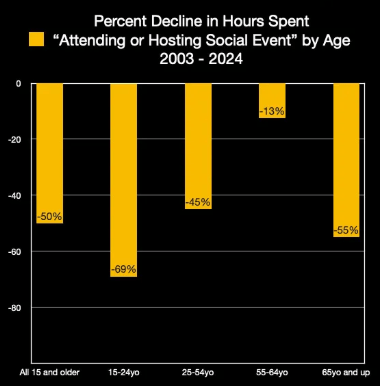
Young people are spending less and less time socializing with each other. The American Time Use Survey estimated a nearly 50% decline in face-to-face interactions among teenagers over the last two decades.

Time that used to be spent with friends is now spent online. When it comes to the “female loneliness crisis,” I’m not even convinced that most people know it exists. You can find column after column on the male loneliness epidemic. But when it comes to the female loneliness epidemic? Crickets.

_____________________________

Growing up, I spent every French school holiday in the U.S. with my dad — the more career-driven of my parents (which tracks, since my mom is Belgian and my dad is a pure-bred American from Michigan). So I grew up with both models: French and American.

I don’t think most French people think about purpose the way Americans do. What’s your purpose? What are you building? What are you here for?

They’re good questions. But in France, they’re not humming in the background of every conversation. Most people I know don’t define themselves by what they do for a living. And if they work in a corporate setting, there’s often this quiet trust that things will evolve over time. No need to panic about your life path. Just do your job — and enjoy your life. Work is one part of the equation. So is your social life, your hobbies, your weekends away.

In the U.S., the idea of having purpose is everywhere: in books, on podcasts, in LinkedIn bios, even in casual brunch conversations. There’s this constant pressure to align your job with your passion, your calendar with your goals, your time with your values.

But what if your purpose is simply to build a good life? To raise kind children. To cook a little better each year. To read a few excellent books. To notice the seasons. To build meaningful relationships. Isn’t that what people will remember anyway?

In France, there’s no guilt in doing a job because it pays the bills. Or because it gives you your evenings. You can be excellent at what you do and still have no desire to talk about it over dinner — which is very much the case with my French husband, who bans work talk at the table. At first it felt strange. Now I love it. We talk about where we want to go next weekend. What we’re reading. What to cook.

When I moved back to Paris as an adult, I was struck by how much people here were just… living. They weren’t building personal brands. They weren’t trying to optimize themselves into more perfect versions. They worked, they took real holidays, they cooked, they went to the theater. They had long conversations about everything and nothing. And they rarely used the word productive.

What they value instead is curiosity. Culture. Taste. The art of paying attention. Of being present, not just purposeful. That doesn’t mean people are passive. But the energy is different. Life is more about living well or profiter de la vie.

It took me time to unlearn the habit of measuring everything by what it might lead to. What goal it served. What version of myself it might create. I still have ambition, but I no longer believe every moment needs to be part of some upward trajectory. Some days, it’s enough to spend the weekend with my family — visiting an exhibition, taking the kids to a play.

I don’t know that I’ll ever stop caring about meaning. But I’ve stopped needing to declare it. What I want now is to live with intention, even when there’s no obvious reward. To build a life that’s full, not optimized.

____________________________

There’s a strange comfort in believing someone out there knows what the market will do next. Don’t fall for it. People who make predictions on the financial markets for a living are about as accurate as a 50/50 coin toss.

By early spring 2025, when President Trump’s tariff wars started, over half of the forecasters were calling for the market to decline.  The below graph shows the level of the S&P 500 at the beginning of the year (orange bar), the actual price level at year end (green bar) and the wide range of estimates published in April (blue bars).  If you’d been reading all their research reports, you might have started selling.

Maybe you’re thinking “Fine. Experts may be clueless, but vibes are easy to read.” You know all about employment numbers, and inflation, and the usual talking points from CNBC.

Well, here’s a great chart from JP Morgan Asset Management that begs to differIt looks at  S&P 500 performance after peaks and troughs in the University of Michigan’s consumer sentiment survey. Interestingly, the weakest moments in how people are feeling  tend to precede strong equity returns while peaks in sentiment do not see as much upside. Turns out that getting out of the market when things feel bad can be a poor investment strategy.

__________________________

The defining feature of every bubble is the same: a growing inconsistency between the long-term returns that investors expect in their heads – based on extrapolation of the past, and the long-term returns that properly relate prices to likely future cash flows – based on valuations.

Each speculative episode encourages a certain stubbornness – because humans are adaptive creatures, we base our expectations for the future on the experience of the recent past. We respond far less to those things that are painful but distant in our memory than to those things that are rewarding in real-time.

This feature of investor behavior – what Galbraith called “the extreme brevity of the financial memory” – is complicated by the crowd psychology that accompanies speculation. Independence of thought requires one “to resist two compelling forces: one, the powerful personal interest that develops in the euphoric belief, and the other, the seemingly superior financial opinion that is brought to bear on behalf of such belief. As long as they are in, they have a strong pecuniary commitment to the belief in the unique personal intelligence that tells them there will be yet more. Speculation buys up, in a very practical way, the intelligence of those involved.”

A related, and I think equally challenging complication is that, in the short run, market prices will be whatever the consensus of the crowd chooses them to be. Nothing that we can measure affects market prices – whether earnings, GDP, employment, interest rates, monetary policy, or any other factor – except through the expectations and risk-preferences in the heads of investors at any moment in time. As the Buddha said, “With our thoughts we create our world.”

A financial “security” is nothing more than a claim on some stream of cash flows that investors expect to be delivered into their hands in the future. For any stream of future cash flows, and some long-term rate of expected return, we can always calculate the “present value” of the cash flows expected at each point in the future. Likewise, once we have a reasonable estimate of likely future cash flows, then the moment we know the market price, it’s just arithmetic to calculate the expected long-term rate of return on the investment.

Over the short-run, however, nothing prevents investors from imagining whatever long-term rate of return they like, and paying whatever price they wish, even if the two are mathematically incompatible with likely future cash flows. Even then, we can make everything compatible by imagining whatever future cash flows we like. Only time imposes any discipline on those choices, and sometimes time is unforgiving.

Over the short run, all that matters is the return in people’s heads. It’s only over time that the cash flows arrive and reliably teach investors that valuations matter. That’s why Ben Graham wrote “In the short run, the market is a voting machine, but in the long run, it is a weighing machine.”

_________________________________

Will LLM models run out of data to train on? In its 2025 AI Index Report, Stanford concluded that this is unlikely before 2030. Common Crawl, an open repository of web crawl data frequently used in AI training, is estimated to contain a median of 130 trillion tokens. The indexed web holds approximately 510 trillion tokens, while the entire web contains around 3,100 trillion. Additionally, the total stock of images is estimated at 300 trillion tokens, and video at 1,350 trillion tokens.

Assume that 5 billion people end up using AI by the 2030’s (compared to 6 billion current internet users). Each user consumes about 1.6 mm tokens per day for search, coding assistance, other agents, background
assistants and creative purposes. That would be a LOT of demand vs current levels and assumes a paradigm
shift in how AI is used in daily life. Across all users, that would be 8 quadrillion tokens per day

How much capacity would be needed to handle 8 quadrillion tokens per day? 23 – 92 Gigawatts of active
inference capacity. While there are 125 Gigawatts of data centers around the world, only about 20 Gigawatts are currently estimated to be capable of handling AI workloads.

What is the constraint to grow toward the Gigawatts needed? Energy.

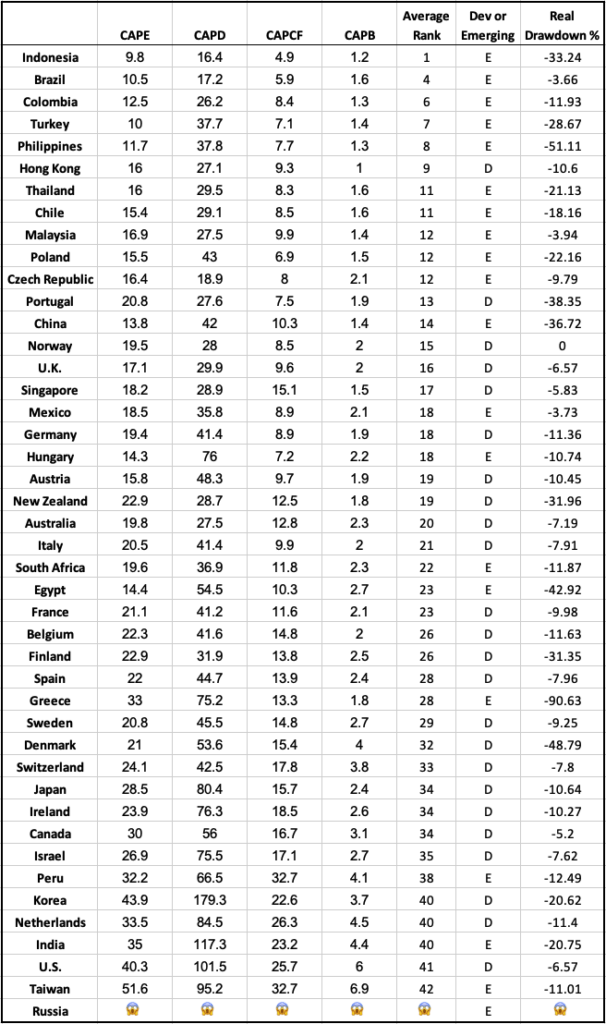
Q1 2026 Global Stock Market Valuations By Country

A higher price to earnings ratio (CAPE) means a country’s stock market is more expensive. A lower number is less expensive.

  • United States Stock Market: 38
  • Average of Foreign Developed Stock Markets: 22
  • Average of Foreign Emerging Stock Markets: 19

The rankings below show the price you are paying for the earnings, dividends, cash flow and book value for the companies within these countries.

*Abbreviations:
CAPE: Cyclically Adjusted Price Earnings – a valuation measure that uses real earnings per share (EPS) over a 10-year period to smooth out fluctuations in corporate profits that occur over different periods of a business cycle.
CAPD: Cyclically Adjusted Price Dividends – a valuation measure that uses dividends over a 10-year period to smooth out fluctuations in corporate profits that occur over different periods of a business cycle.
CAPCF: Cyclically Adjusted Price Cash Flow – a valuation measure that uses cash flow over a 10-year period to smooth out fluctuations in corporate profits that occur over different periods of a business cycle.
CAPB: Cyclically Adjusted Price Book – a valuation measure that uses book value over a 10-year period to smooth out fluctuations in corporate profits that occur over different periods of a business cycle.

Source: The Idea Farm